
AI in Schools: Solving the Teacher Crisis Through Operational Efficiency

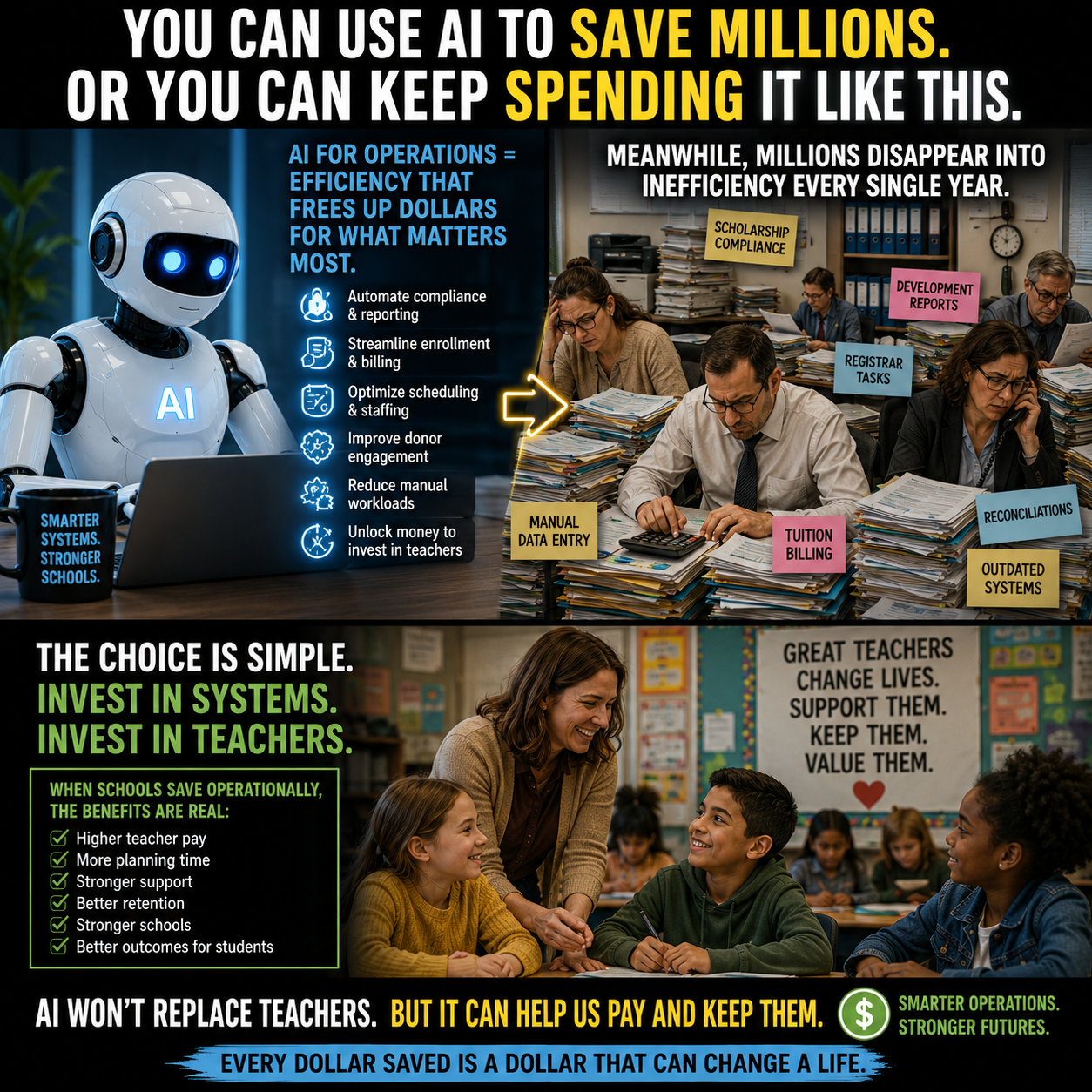
Schools are facing a quiet crisis that many leaders are reluctant to confront honestly. Teachers are leaving the profession in alarming numbers, fewer young people are choosing to become educators, and the emotional demands placed upon teachers continue to rise. At the very moment schools need to strengthen and support the people doing the most important work, many institutions are spending enormous amounts of money maintaining outdated operational systems that artificial intelligence could dramatically improve.

The conversation surrounding artificial intelligence in schools has largely centered on teaching and learning. School leaders debate whether students should use ChatGPT, whether teachers should use AI for lesson planning, and whether AI will transform instruction. Meanwhile, one of the greatest opportunities in education is being overlooked entirely. Artificial intelligence has the potential to optimize school operations, reduce administrative inefficiencies, and free up significant operating dollars that could be redirected toward teacher compensation, teacher support, and teacher retention.

The research on teacher dissatisfaction is impossible to ignore. According to the National Education Association, teacher salaries have failed to keep pace with inflation for more than a decade. Although the average public school teacher salary reached approximately $74,495 during the 2024 to 2025 school year, teachers are still earning less in real purchasing power than they did ten years ago. Starting salaries remain especially problematic, averaging approximately $48,112 nationally. For many young educators burdened with student debt and rising housing costs, the economics of teaching no longer make sense.

The Economic Policy Institute recently reported that teachers now earn nearly 27 percent less than similarly educated professionals working in other fields. This teacher wage penalty is one of the largest on record. At the same time, teachers are being asked to manage increasing behavioral challenges, growing mental health concerns among students, rising parental expectations, and mounting administrative responsibilities.

The result is predictable. Teachers are exhausted.

RAND Corporation research continues to show that teachers experience significantly higher levels of stress and burnout than comparable working adults. Many educators report feeling emotionally drained, professionally unsupported, and overwhelmed by responsibilities that extend far beyond teaching. Teachers are not simply leaving because of salary alone. They are leaving because the structure of the profession has become increasingly unsustainable.

This is where school leaders need to ask a difficult but necessary question.

Why are schools investing so heavily in expanding administrative systems while failing to explore how artificial intelligence could streamline operations and redirect resources toward people?

Most schools continue to rely upon highly fragmented systems requiring large amounts of repetitive human labor. Enrollment management, donor reporting, registrar functions, billing, tuition management, scholarship compliance, payroll processing, scheduling, communication systems, and data reporting often operate in disconnected silos. Many of these processes consume thousands of staff hours each year.

Artificial intelligence can now automate or significantly streamline many of these operational functions.

AI powered workflow systems can verify forms, monitor compliance requirements, generate reports, automate communications, analyze enrollment patterns, improve donor prospecting, optimize staffing models, and reduce duplication of effort across departments. Intelligent systems can identify inefficiencies that human administrators may never see because they are buried inside daily operational demands.

This does not mean eliminating the human element in schools. Quite the opposite.

The goal should not be replacing people. The goal should be allowing talented people to spend more time doing meaningful work instead of repetitive administrative tasks. Schools should be using technology to reduce bureaucratic friction while reinvesting savings into the classroom experience and the people who make schools extraordinary.

Imagine if schools redirected even a portion of operational savings toward teacher compensation, wellness initiatives, mentorship programs, professional growth opportunities, or additional planning time. Imagine if schools reduced administrative overload so teachers could focus more deeply on relationships, creativity, innovation, and personalized instruction.

Many schools claim they cannot afford to pay teachers more. The more important question may be whether schools are allocating resources in ways that reflect their stated priorities.

If teachers are truly the heart of a school, budgets should reflect that reality.

Artificial intelligence presents an opportunity for educational institutions to rethink how schools operate. Forward thinking organizations in other industries are already using AI to optimize logistics, customer communication, scheduling, compliance, forecasting, and operational efficiency. Education, however, often remains structurally resistant to operational redesign.

Ironically, schools are attempting to prepare students for an AI driven future while many of their own operational systems remain rooted in practices from decades ago.

The schools that thrive in the coming decade will likely be the ones courageous enough to rethink not only instruction, but the architecture of the institution itself. They will ask how technology can strengthen human connection rather than weaken it. They will use AI to eliminate inefficiency rather than increase bureaucracy. Most importantly, they will intentionally reinvest operational savings into attracting and retaining exceptional educators.

The teacher shortage is not simply a staffing issue. It is a structural issue.

Teachers cannot continue carrying the emotional, intellectual, and operational weight of modern education without meaningful institutional change. Asking educators to simply become more resilient while systems remain inefficient is not leadership. It is avoidance.

Artificial intelligence will not solve every problem facing schools. But used wisely, it may help create something education desperately needs right now: operational breathing room.

And perhaps the greatest opportunity of all is this. Every dollar saved through smarter systems is a dollar that can be reinvested into the people who shape the future of children every single day.

If school leaders do not know where to begin, they should start by asking for help and beginning the process. Schools across the country have spent enormous amounts of time debating student AI policies while giving far less attention to how artificial intelligence could strengthen the institution itself. Educational leaders have both a moral and fiscal responsibility to examine where AI can improve workflow systems, reduce operational inefficiencies, and maximize resources that could be redirected toward teacher salaries, support, and retention. At a time when schools are struggling to keep great educators in the profession, it is no longer enough to simply talk about valuing teachers. School budgets, operational decisions, and strategic priorities must reflect that value in tangible ways. The schools that thrive in the future will not be the ones that fear artificial intelligence. They will be the ones wise enough to use it to invest more deeply in people.

Sources

National Education Association. “Educator Pay and Student Spending.”
National Education AssociationAttachment.png

Economic Policy Institute. “The Teacher Pay Penalty Hit a Record High in 2024.”
Economic Policy InstituteAttachment.png

RAND Corporation. “Teacher Well Being and Intentions to Leave.”
RAND CorporationAttachment.png

Organisation for Economic Co operation and Development. “AI Adoption in Education Systems.”
OECD ReportAttachment.png

Microsoft Education. “2025 AI in Education Report.”
Microsoft Education ReportAttachment.png

Posted in Uncategorized | Tagged , , , , | Leave a comment

We Say We Value Durable Skills. So Why Don’t We Build Schools to Develop Them?

There is a growing disconnect in education that we can no longer ignore. On one hand, employers, higher education leaders, and organizations like America Succeeds are clear about what matters most: communication, collaboration, critical thinking, adaptability, and leadership. These are often referred to as durable skills because they remain relevant no matter how the world changes.

On the other hand, most schools are still designed around a very different set of priorities. Students move from class to class. Content is delivered in segments. Success is measured through standardized assessments and advanced coursework like AP classes.

To be clear, this is not about dismissing academic rigor. Mastering content matters. Deep knowledge matters. But the question we should be asking is this: What is our system actually optimized to produce?

Because systems always produce what they are designed to produce. And right now, most schools are optimized for coverage, compliance, and performance on exams—not for the development of durable, transferable skills.

This is not a failure of teachers. It is not a failure of students. It is a failure of design. Some emerging models are beginning to show us what a different approach might look like.At Alpha School, for example, core academic instruction is compressed into a focused two-hour block each day. The purpose is not to reduce learning, but to create something our current system lacks: time. Time for students to engage in the arts, athletics, entrepreneurship, internships, and collaborative projects.

Time to practice communication in real contexts.
Time to lead.
Time to fail, adapt, and try again.

In other words, time to actually develop the skills we claim to value. Contrast that with the traditional model, where much of a student’s day is spent preparing for assessments that measure what they know, often in isolation, under time pressure, with little connection to how that knowledge will be used. It raises an uncomfortable but necessary question: If we were designing schools today from scratch, knowing what we know about the future, would we build what we currently have? Or would we design something fundamentally different?

After more than 30 years in education, I believe we are at an inflection point. We can continue to add more. Or we can redesign. Because the future will not reward those who simply know more. It will reward those who can think, adapt, lead, and create. And those are not skills you develop by accident. They are skills you design for.

So here is the question I would genuinely love to hear perspectives on:

If you had the freedom to redesign a student’s day from the ground up, how much time would you dedicate to content mastery—and how much to developing durable, real-world skills?

Posted in Uncategorized | Tagged , , , , , , , | Leave a comment

We Say We Want Future-Ready Students. Our Testing System Says Otherwise

For decades, we have claimed that education must evolve.

We talk about creativity, critical thinking, adaptability, and purpose.
We talk about preparing students for a world shaped by artificial intelligence, rapid change, and global complexity.

And yet, we continue to rely on standardized tests to tell us who is “smart.”

There is a disconnect here that we can no longer ignore.

Standardized tests were built for a different time.
They were designed to sort, rank, and standardize during the industrial age when efficiency and uniformity were the goal.

But that is not the world our students are entering.

Today, success requires originality, resilience, collaboration, and the ability to think in ways that cannot be captured in a multiple-choice format. And still, we devote enormous amounts of time in schools to preparing students for exams that measure a narrow slice of human capability.

Programs like Advanced Placement, administered by the College Board, add another layer to this system. On the surface, they offer rigor and the promise of college credit. In practice, they reinforce the same model of standardized assessment.

AP courses often become another sorting mechanism.
They reward students who test well within a very specific structure and pace, while overlooking many others who are equally capable but demonstrate their strengths differently.

And the stakes are high.

Students are told that these scores define readiness.
That they determine access.
That they signal who is ahead and who is not.

At the same time, this system has become a powerful financial engine. Families pay for tests, for preparation, for multiple attempts. Schools invest time and resources to support it. The incentives are clear, and they are not always aligned with what is best for students.

What we call “merit” is often shaped by access to preparation, repetition, and familiarity with the test itself.

And students who are capable, curious, and driven can be left behind because they do not perform well in a narrow, timed, standardized environment.

This is not just a measurement problem. It is a design problem.

If we are serious about preparing students for the future, we need to rethink what we value and how we measure it.

Assessment should not be about sorting students into narrow categories.
It should be about understanding how they think, how they grow, and how they contribute over time.

We need systems that recognize multiple forms of excellence:

The student who can design and build
The student who can lead and inspire
The student who can solve complex, real-world problems
The student who demonstrates resilience, curiosity, and purpose over time

These are not secondary skills. They are the skills that will define the future.

And they are largely invisible in our current models.

This does not mean abandoning standards or accountability.
It means evolving them.

Portfolio-based assessment
Performance tasks
Capstone projects
Internships and real-world application
Longitudinal demonstrations of growth

These approaches already exist. Many schools are moving in this direction. Higher education is beginning to follow. Employers have been signaling this shift for years.

The question is not whether change is possible.

It is whether we are willing to let go of systems that feel familiar but no longer serve our students.

We cannot continue to say we are preparing students for the future while measuring them with tools from the past.

If we truly believe in the potential of every child, then our assessment systems must reflect the many ways that potential can be realized.

Anything less is not just outdated.

It is misaligned with the future we claim to be building.

Posted in Uncategorized | Leave a comment

Shifting Paradigms in Education: The Quiet Crisis and the Future Worth Building

Something fundamental is shifting in education.
This video is a glimpse into that shift and the ideas behind my new book, The Quiet Crisis and the Future Worth Building.

Posted in Uncategorized | Leave a comment

The Quiet Crisis and the Future Worth Building

AI isn’t changing education at the margins. It’s exposing that the system itself needs redesign. This is the conversation behind The Quiet Crisis and why he future of school cannot look like the past. It is now available on Amazon!

https://a.co/d/08GJMuCf

Posted in Uncategorized | Leave a comment

Rethinking Educational Leadership in the Age of AI

Artificial Intelligence and the Courage to Rethink Educational Leadership

After more than 30 years in education, I recently found myself considering a return to senior school administration. It is work I know well and loved deeply.

After reflection from a recent school visit and a long drive home filled with honest conversation, I reached clarity.

Education is approaching a marketplace disruption, and many systems are not yet ready to respond.

This realization does not come from theory or trend watching. It comes from lived experience.

I’ve Seen This Kind of Disruption Before

Early in my career, I served as a teacher, technology coordinator, and later as a director of educational technology and innovation during the rise of mobile computing. I was there when laptops entered classrooms, when iPads promised new forms of engagement, and when smartphones, particularly iPhones, became nearly ubiquitous in students’ lives.

At the time, many of us worked carefully to integrate these tools with sound pedagogy. Phones were calculators, cameras, organizers, research devices and tools to inspire and use creativity to design projects that deepened learning. The intention was thoughtful and student centered.

But technology evolves, and so do its consequences.

Over time, it became increasingly clear that constant connectivity and the forward facing camera embedded in smartphones were shaping student behavior in ways we did not fully anticipate. These changes included attention fragmentation, social comparison, rising anxiety, and diminished presence.

Leadership required a shift.

About four years ago, I was part of leading the decision to remove phones from classrooms. This decision was not made because technology is inherently harmful, but because discernment matters. We listened to teachers, observed students closely, and responded to emerging research on adolescent well being and the crisis unfolding before our eyes.

That experience reinforced a lesson I had learned before.

Progress is not just about adoption. It is also about reassessment.

Disruption Under Pressure Lessons From COVID

That lesson became even clearer during COVID.

Like many technology leaders and educators, I spent that period working alongside teachers, schools, and families as learning shifted almost overnight into hybrid and remote environments. There were no playbooks, only principles.

The work was not about platforms or tools. It was about helping adults ask important questions. What truly matters for student learning right now. How do we maintain connection when we are physically apart. What expectations are humane, and what can we let go?

Some of what we tried worked. Some did not. What carried us through was a shared commitment to sound pedagogy, flexibility, and care for students, teachers, and families alike.

That period reminded me that technology can support learning, but it cannot replace relationships or tools and pedagogy that were needed to support students’ various learning styles, strengths, and weaknesses.

Artificial Intelligence Is the Next Inflection Point

Artificial intelligence feels new, but the pattern is familiar.

AI is a disruptor much like mobile computing was 25 years ago. Entire industries did not change because leaders were reckless. They changed because leaders were responsive.

The taxi industry offers a useful analogy. Before Uber and Lyft, the experience had stagnated. When disruption arrived, it was not just about technology. It was about reimagining service, including cleaner cars, respectful drivers, transparency, and ease. Consumers did not need persuasion. The market responded.

Education is now at a similar moment.

What AI Makes Possible and What It Requires

Used wisely, artificial intelligence can assess and personalize learning at scale. It can identify skill gaps in real time. It can reduce administrative burden so teachers can focus on mentorship and feedback. It can shift learning from time based to mastery based models. It can create space for curiosity, creativity, and purpose.

If we have learned anything from smartphones, it is this.

Tools shape culture.

How we integrate artificial intelligence, or rush to deploy it, will matter just as much as whether we adopt it at all.

The Readiness Gap

What concerns me is not resistance, but delay.

Many schools talk about innovation, yet struggle to take instructional risks. Innovation spaces remain underused. Classrooms remain largely didactic. Students are overloaded with schedules packed with Advanced Placement courses aimed at standardized tests that reveal little about adaptability, wisdom, or flourishing in an AI shaped world.

Meanwhile, new schools are emerging thoughtfully and responsibly. They are rethinking instruction, assessment, and time. Early data from these models is promising when compared to traditional outcomes.

The difference is not resources.

It is posture.

Why I’m Choosing a Different Path

I recently wrote The Virtue Code: A Guide to Flourish for the AI Generation, a book about human virtues in the age of artificial intelligence. That work was shaped by decades of walking alongside educators with students and their familiies through moments of disruption, including mobile computing, smartphones, COVID, and now AI.

At this stage of my life, I no longer feel called to return to systems that resist both sides of leadership. The courage to innovate matters. The courage to pause when harm emerges matters just as much.

Instead, I want to support educators and institutions already preparing for what comes next. These are the schools and leaders willing to redesign learning with wisdom, humility, and care.

This is not burnout.

It is discernment.

The Constant That Has Never Changed

Across every technological shift, one truth remains.

The students are extraordinary.

They are perceptive, adaptable, and deeply affected by the systems we design around them. They deserve adults who are willing to learn, unlearn, and relearn in service of their growth.

A Hopeful Invitation

Education is not failing. It is being invited to evolve.

Artificial intelligence, like every disruption before it, will reward leaders who pair curiosity with humility, innovation with virtue, and progress with care.

I am choosing to spend this next chapter helping build what comes next by supporting schools and leaders ready to shape the future of learning wisely and humanely.

The future of education is not something to fear.

It is something to build together.

References

Jonathan Haidt (2024). The Anxious Generation.

Twenge, Jean M. (2017). iGen.

Organisation for Economic Co operation and Development. (2021 to 2023).

Darling Hammond, Linda, et al. (2020). Restarting and Reinventing School: Learning in the Time of COVID and Beyond.

Posted in Uncategorized | Tagged , , , , , , , , , | Leave a comment

The Value of an Open Mind and Intention: Embracing the Next Chapter with Purpose

After an incredibly rewarding tenure as an Assistant Head of School, Head of Upper School, and Director of Innovation, I embarked on a transition that has opened doors to some truly extraordinary experiences. It’s a testament to the power of a positive and open mindset—the willingness to say “yes” to the unexpected, to step far outside one’s professional comfort zone, and to see every new challenge as a profound opportunity for growth.

In the last 10 weeks, I’ve had the privilege of engaging in what many would consider once-in-a-lifetime experiences, each one demanding a different form of intellectual and physical engagement:

  • Intellectual Pursuit & Creativity: Channeling years of insight and experience into the written word. I’m excited to have recently published several new books, including an upcoming children’s series. This allows me to continue teaching and mentoring across different generations and platforms.
  • Service and Resilience: Completing a long-distance open water swim for The Honor Foundation alongside my husband and members of the special operations community. This was a powerful lesson in collective endurance and the profound impact of supporting those who serve.
  • A Deeper Understanding of Transition: Visiting SOFCOM in Tampa to collaborate with transitioning special operators. Bringing my perspective on organizational leadership and change management to help these incredible individuals navigate their shift to civilian life has been an immensely humbling and insightful experience.
  • Connection and Perspective: Finding balance and focus through challenging outdoor pursuits, such as elk and deer hunting on a beautiful Montana ranch. These experiences offer a deep connection to nature and a powerful sense of presence that recharges the spirit.
  • The Ultimate Priority: Of course, the most precious opportunities have been personal—the time spent visiting my children and grandchildren in Phoenix, Chicago, North Carolina and Del Ray Beach, Florida reinforcing the importance of family as the ultimate grounding force.

My journey is a reminder that the skills we hone in education—leadership, problem-solving, empathy, curiosity, and a thirst for knowledge—are universally applicable.

If you are facing a professional change, I encourage you to see it not as an end, but as a boundless space for new learning. An open mindset with a little courage and intentionality to take the first step and get started are the keys that unlock these diverse opportunities, allowing us to leverage our core strengths in service of new missions.

I’m incredibly grateful for the education community that shaped my past, and I’m excited to see where this current mindset of curiosity and creation leads next.

#Leadership #Transition #Mindset #Author #ChildrensBooks #TheHonorFoundation #ExecutiveCoaching #GrowthMindset

Posted in Uncategorized | Tagged , , , , | Leave a comment

Giving, Gratitude, and The Virtue Code

In life and leadership, I believe the measure of our impact is not in how much we take, but in how much we give.

Research shows that those who consistently give — their time, their wisdom, their resources, their kindness — experience greater fulfillment, stronger relationships, and even longer lives. Giving not only deepens relationships and strengthens communities; it reshapes our own sense of meaning and purpose.

During my 30 year career, I’ve been blessed to work with incredibly talented students who understand this truth at a young age. After hurricanes, I watched them rally to help neighbors in need. I’ve seen them start nonprofits, lead service projects, and give of themselves in ways that far exceed their years. They know instinctively that life is richer when you give more than you take.

And last weekend, I had my own reminder of that truth. Joe and I joined The Honor Foundation’s open-water swim to benefit special operations forces. Now, let me be honest — I’m no Olympian or strong swimmer who looks forward to the pool, even in Florida where I live. But out there in the waves, what struck me most wasn’t just finishing the swim (though I was beyond grateful for that, too!). It was the sheer number of people who gave their time, energy, and encouragement to make the event possible. Their generosity and joy turned a risky ocean swim into a celebration of service. I left feeling humbled, inspired, and a little waterlogged — but mostly grateful to be reminded that there is always time to serve others.

This is the heart of servant leadership: putting others first, lifting them up, and finding meaning not in what you gain, but in how you help others flourish. It’s also at the center of The Virtue Code, where I write about the power of intention, gratitude, and connection. When we give generously, we don’t just shape better communities — we shape better selves.

The words of the Prayer of Saint Francis come to mind: “For it is in giving that we receive.” Every loving thought, every shared idea, every act of kindness returns to us in ways we cannot predict — a hundredfold.

In the end, it is not what we acquire, but what we give away that makes life incredibly meaningful and beautiful. That’s why I wrote The Virtue Code — to remind us that the richest life is the one rooted in giving, gratitude, and connection.

“We make a living by what we get, but we make a life by what we give.” – Winston Churchill

Posted in Uncategorized | Tagged , , , , , , , , , | Leave a comment

AI Chatbots & Connection

Posted in Uncategorized | Tagged , , , , | Leave a comment

The Power of Human Connection: Why Taking Phones from Kids Matters Now More Than Ever

In the recent years working with teenagers, I have felt the dramatic power phones have over our children, not to mention their parents who do much of their professional work 24/7 from them in our constantly connected world. During the last two years, I have become increasingly worried even after banning mobile phones at school in 2022. Why? Artificial intelligence (AI) is blurring the boundaries between reality and virtual solace, too many children are leaning on chatbots when they do have their phones and it’s not to complement human relationships, but to replace them. AI was initially used to offload productivity tasks, and now it’s used for emotional tasks. Imagine that; According to a study of 2000 Gen Zers by Joi AI, a chatbot company, 83% believe they can form a deep emotional connection with AI. This shift isn’t just worrisome—it risks the very essence of humanity and could worsen the mental health crisis gripping our society.

Current data reveals alarming trends as cited by Common Sense Media painting a stark portrait of the growing reliance on AI companions among U.S. teenagers:

These numbers are more than percentages. They represent a generation increasingly mistaking digital simulations for meaningful relationships for three reasons to start.

1. Replacing Real Connection with Simulation

Chatbots can mimic emotional warmth and empathy, offering immediate comfort. Yet, unlike real human relationships, they lack depth, vulnerability, and true reciprocity. Human connection can be messy, like some of the greatest challenges we will have to overcome. Statistics show many teens are choosing AI over humans for serious conversations, a shift that could stunt emotional development (New York Post, AP News, Teen Vogue).

2. Emotional Dependence and Psychological Risks

Academic research indicates that people with fewer real-world connections are more likely to turn to AI companions—and that such usage is linked to lower well-being, particularly among heavy users (arXiv). Other studies highlight risks of “artificial intimacy,” where emotional attachments to AI mirror human relationships but lack authenticity, potentially leading to social withdrawal and difficulty forming real bonds (arXiv, Wikipedia).

3. Real Harm: Cases of AI-Driven Distress

Tragically, there are documented instances where emotionally responsive chatbots contributed to crisis situations—including suicides—due to encouragement or misguided responses (Wikipedia). These stories underline how unregulated AI can exacerbate vulnerable states, especially when alternative support systems are lacking.

Why Removing Phones—and Limiting Chatbot Access—is a Critical Step

Taking phones away from kids isn’t about censorship—it’s about creating space. When children are smartphone-free:

  • They rediscover the power of presence, empathy, and genuine connection. Without the instant gratification in their hands the potential for them to use their minds and imaginations to be creative and connect with others increases significantly. I watched them pick up a ball and begin kicking it around the field or simply talk to their classmates about virtually everything.
  • Family, friends, and communities re-emerge as essential sources of support. Students turn to one another instead of their devices. Imagine a student engaging in conversation with peers or teachers about the many happenings in their lives to get authentic responses by individuals with whom they share a school or family! It matters.
  • Kids learn to sit with discomfort, conflict, humor, and joy—things no AI can authentically deliver. Helping students build resilience, problem solving, self awareness, and social awareness to manage relationships leads to developed emotional quotients and happiness. Harvard’s longest, multigenerational study revealed that close, warm relationships are a stronger predictor of happiness, health, and longevity than wealth, intelligence, or social status. AI chatbot access has the potential to do incredible harm to the long term mental health and happiness of our society!

In fostering real connection, we’re not withdrawing a convenience—we’re gifting resilience, empathy, and the ability to flourish together.

The good news is that we can reclaim humanity through connection. The data is clear: AI chatbots are filling emotional voids—but they cannot replace the human heart. As 52% of teens now visit these platforms monthly and 13% daily, we must question what’s being lost: real dialogue, empathy, vulnerability.

By stepping in, setting boundaries, and encouraging face-to-face interaction, we protect more than social skills. We guard against isolation, emotional distortion, and a generation drifting into artificial intimacy. Let’s give our children something truly irreplaceable: the chance to grow, connect, and understand the power of humanity.

Posted in Uncategorized | Tagged , , , , , | Leave a comment