
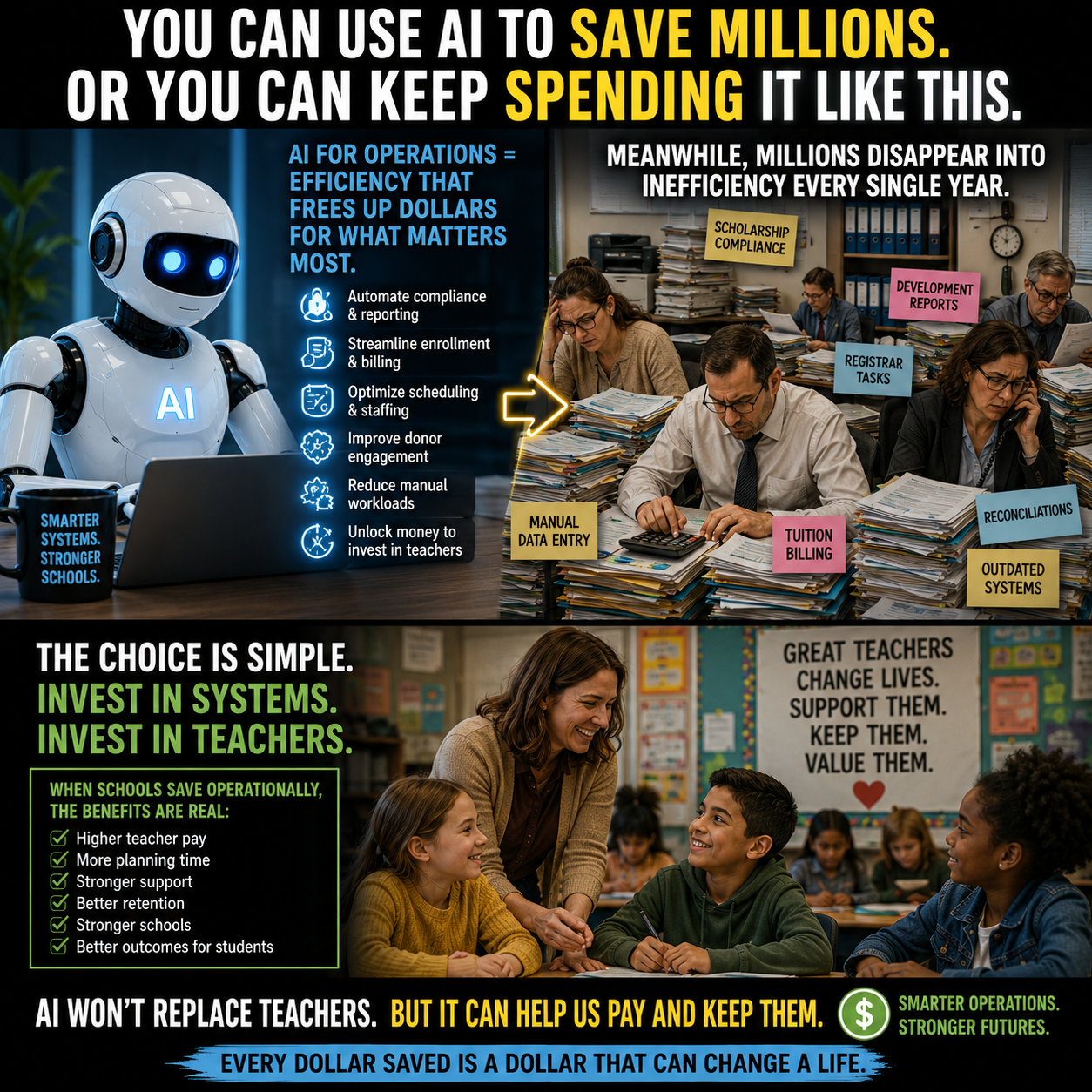
Schools are facing a quiet crisis that many leaders are reluctant to confront honestly. Teachers are leaving the profession in alarming numbers, fewer young people are choosing to become educators, and the emotional demands placed upon teachers continue to rise. At the very moment schools need to strengthen and support the people doing the most important work, many institutions are spending enormous amounts of money maintaining outdated operational systems that artificial intelligence could dramatically improve.
The conversation surrounding artificial intelligence in schools has largely centered on teaching and learning. School leaders debate whether students should use ChatGPT, whether teachers should use AI for lesson planning, and whether AI will transform instruction. Meanwhile, one of the greatest opportunities in education is being overlooked entirely. Artificial intelligence has the potential to optimize school operations, reduce administrative inefficiencies, and free up significant operating dollars that could be redirected toward teacher compensation, teacher support, and teacher retention.
The research on teacher dissatisfaction is impossible to ignore. According to the National Education Association, teacher salaries have failed to keep pace with inflation for more than a decade. Although the average public school teacher salary reached approximately $74,495 during the 2024 to 2025 school year, teachers are still earning less in real purchasing power than they did ten years ago. Starting salaries remain especially problematic, averaging approximately $48,112 nationally. For many young educators burdened with student debt and rising housing costs, the economics of teaching no longer make sense.
The Economic Policy Institute recently reported that teachers now earn nearly 27 percent less than similarly educated professionals working in other fields. This teacher wage penalty is one of the largest on record. At the same time, teachers are being asked to manage increasing behavioral challenges, growing mental health concerns among students, rising parental expectations, and mounting administrative responsibilities.
The result is predictable. Teachers are exhausted.
RAND Corporation research continues to show that teachers experience significantly higher levels of stress and burnout than comparable working adults. Many educators report feeling emotionally drained, professionally unsupported, and overwhelmed by responsibilities that extend far beyond teaching. Teachers are not simply leaving because of salary alone. They are leaving because the structure of the profession has become increasingly unsustainable.
This is where school leaders need to ask a difficult but necessary question.
Why are schools investing so heavily in expanding administrative systems while failing to explore how artificial intelligence could streamline operations and redirect resources toward people?
Most schools continue to rely upon highly fragmented systems requiring large amounts of repetitive human labor. Enrollment management, donor reporting, registrar functions, billing, tuition management, scholarship compliance, payroll processing, scheduling, communication systems, and data reporting often operate in disconnected silos. Many of these processes consume thousands of staff hours each year.
Artificial intelligence can now automate or significantly streamline many of these operational functions.
AI powered workflow systems can verify forms, monitor compliance requirements, generate reports, automate communications, analyze enrollment patterns, improve donor prospecting, optimize staffing models, and reduce duplication of effort across departments. Intelligent systems can identify inefficiencies that human administrators may never see because they are buried inside daily operational demands.
This does not mean eliminating the human element in schools. Quite the opposite.
The goal should not be replacing people. The goal should be allowing talented people to spend more time doing meaningful work instead of repetitive administrative tasks. Schools should be using technology to reduce bureaucratic friction while reinvesting savings into the classroom experience and the people who make schools extraordinary.
Imagine if schools redirected even a portion of operational savings toward teacher compensation, wellness initiatives, mentorship programs, professional growth opportunities, or additional planning time. Imagine if schools reduced administrative overload so teachers could focus more deeply on relationships, creativity, innovation, and personalized instruction.
Many schools claim they cannot afford to pay teachers more. The more important question may be whether schools are allocating resources in ways that reflect their stated priorities.
If teachers are truly the heart of a school, budgets should reflect that reality.
Artificial intelligence presents an opportunity for educational institutions to rethink how schools operate. Forward thinking organizations in other industries are already using AI to optimize logistics, customer communication, scheduling, compliance, forecasting, and operational efficiency. Education, however, often remains structurally resistant to operational redesign.
Ironically, schools are attempting to prepare students for an AI driven future while many of their own operational systems remain rooted in practices from decades ago.
The schools that thrive in the coming decade will likely be the ones courageous enough to rethink not only instruction, but the architecture of the institution itself. They will ask how technology can strengthen human connection rather than weaken it. They will use AI to eliminate inefficiency rather than increase bureaucracy. Most importantly, they will intentionally reinvest operational savings into attracting and retaining exceptional educators.
The teacher shortage is not simply a staffing issue. It is a structural issue.
Teachers cannot continue carrying the emotional, intellectual, and operational weight of modern education without meaningful institutional change. Asking educators to simply become more resilient while systems remain inefficient is not leadership. It is avoidance.
Artificial intelligence will not solve every problem facing schools. But used wisely, it may help create something education desperately needs right now: operational breathing room.
And perhaps the greatest opportunity of all is this. Every dollar saved through smarter systems is a dollar that can be reinvested into the people who shape the future of children every single day.
If school leaders do not know where to begin, they should start by asking for help and beginning the process. Schools across the country have spent enormous amounts of time debating student AI policies while giving far less attention to how artificial intelligence could strengthen the institution itself. Educational leaders have both a moral and fiscal responsibility to examine where AI can improve workflow systems, reduce operational inefficiencies, and maximize resources that could be redirected toward teacher salaries, support, and retention. At a time when schools are struggling to keep great educators in the profession, it is no longer enough to simply talk about valuing teachers. School budgets, operational decisions, and strategic priorities must reflect that value in tangible ways. The schools that thrive in the future will not be the ones that fear artificial intelligence. They will be the ones wise enough to use it to invest more deeply in people.
Sources
National Education Association. “Educator Pay and Student Spending.”
National Education Association
Economic Policy Institute. “The Teacher Pay Penalty Hit a Record High in 2024.”
Economic Policy Institute
RAND Corporation. “Teacher Well Being and Intentions to Leave.”
RAND Corporation
Organisation for Economic Co operation and Development. “AI Adoption in Education Systems.”
OECD Report
Microsoft Education. “2025 AI in Education Report.”
Microsoft Education Report


