
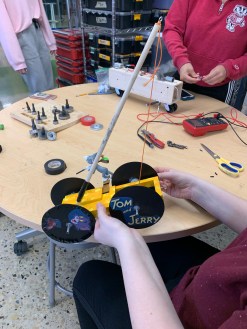
 It was the week before first semester finals, or what is now termed Demonstrations of Learning (DOL), for the students that I work with at a well-resourced, highly achieving independent school. Students are accustomed to preparing for final examinations that have historically been done on paper. They complete free response, true/false, and multiple choice questions, complete empty maps and solve complex math and science equations among many other things that, for the most part, have not changed the last century. Students are extremely comfortable in this arena where they can expect much of the same evaluative processes with different content. As a student, I remember the comfort that accompanied the memorization of vocabulary terms across disciplines, writing papers, solving complicated problems, and completing essay questions. It was predictable and I could prepare, or in most cases, over prepare to tackle those assessments much the way students do today. In fact, I don’t see them playing games on their phones to solve problems or learn vocabulary. The use of notecards, notebooks, and Google docs, on occasion, are what I see the majority of students using to prepare for exams. The way they prepare is not that much of a departure from the past.
Predictability is exactly why students now struggle with assessments that require them to employ physics concepts to design, construct, qualify, and race a mouse trap car that will be measured in speed and distance that it travels, as well as the weight of the load it can pull the longest distance. Basically their mousetrap cars will compete in three different races that measure speed, distance, and endurance. It’s not a predictable assessment and for the most part is a messy project with no straight line to success. Students love to complain about how hard it is to actually build something and why it’s challenging to manage the time it takes to complete.
Students would be evaluated by their physics teachers who have prepared them well in class, Dr. Brigit McEwen and Dr. Amber Bakkum, using several instruments and a grading rubric with points assigned to each descriptor. The rubric included two categories: Qualification and Competition. Qualification included producing a car before the due date at 4 pm, that it was powered only by a single mouse trap, could travel one meter, had a minimum mass of 200g, and could fit within the racing lane that was 40cm in length and 30 cm wide. The Competition category was based on ranking in each of three races. In addition, students had to create a digital record with descriptors of their project including force diagrams, qualitative motion graphs, written, and pictorial documentation of the process, and a reflection on the success/failure of the project. It had to be neat, typed, and organized in a journal with points allocated to each component. Clearly, it was a project that required time and that’s why they were given a whole month to work on it!
Yesterday, the students I worked with remarked that they could predict the amount of time and methods they would use to be successful traditional test takers and were “freaked-out” by the unpredictability of their cars as they revised their prototypes several times to be successful. Of course, most students watched YouTube videos and read as much as they could to figure out how to build a successful car, but they must still actually build the prototypes themselves. There were a host of materials they used, but all must have been recycled materials making the project even more challenging. It’s not like the kids didn’t have time to work on the project; physics teachers provided class time a month ahead of the actual races to make sure students had the support and resources needed; nonetheless, days and hours before the race students became a little frantic. “My car won’t go straight! What can I do?” It’s terrifying for them to NOT know the answer and to have to figure it out without a straight line to the answer.
One colleague remarked that we should get rid of the assessment because it was freaking the kids out, and I couldn’t DISagree more. It is exactly the kind of experience the kids need to figure out without a helicopter there to rush in and save them. Don’t get me wrong, coaching the kids is important especially with the tools they had never used before including laser cutters, stop saws, drills, soldering irons, and 3-D printers. I believe the discomfort, or cognitive dissonance, that they feel during the process helps them to build resiliency which will actually reduce anxiety in the future.
Today is the race, and the kids are ready to go. All of the whining and reconfiguring of schedules to complete the project is behind them. They have grown and seemingly emanate a sense of confidence they didn’t have when the challenging, messy project began. They have learned how to handle situations with teammates when things went wrong with their mousetrap cars, how to better manage time when juggling responsibilities, how to create something from virtually nothing using tools they had never touched before, and some important physics principles. It was an inspiring week in the Lubar Center for Exploration and Innovation working alongside the kids as they navigated a different type of assessment challenge!


